
“Now that’s a lot of questions. Are you sure the candidates answer them? That looks like a bad candidate experience to me.”
Goodness, if I had a dollar for every time I’ve heard that over the years running the CandE Benchmark Research Program – well, I wouldn’t be rich, but I would have enjoyed a lovely dinner.
The concerns are warranted, though. There is research that shows:
- As surveys get longer, response quality declines significantly
- Longer surveys and unpleasant survey experiences reduce future response rates. And those who previously had poor survey experiences are more likely to ignore later surveys.
- Running multiple surveys in the same time period significantly suppresses response rates in later surveys.
The last one above showed why people argue that “too many surveys” cause survey fatigue. However, survey fatigue is often cited but poorly defined in research literature.
When we launched our CandE Benchmark Research Program, there was debate over how many questions to ask. We had input from talent acquisition leaders, recruiters, and data scientists.
What we decided to do was to develop a survey that had minimal required questions that included key ratings and then make the rest of the survey optional and logic-based. Meaning, candidates would answer questions from pre-application to onboarding, and rate those experiences, but they’d only answer questions based on how far they got in the recruiting process.
Most candidates research and apply – and that’s as far as they get. On average, a much smaller group gets screened further, interviewed, made offers to, and hired if they accepted. Which means only those who were hired answer the most questions. And because they were hired they are more willing to answer more questions.
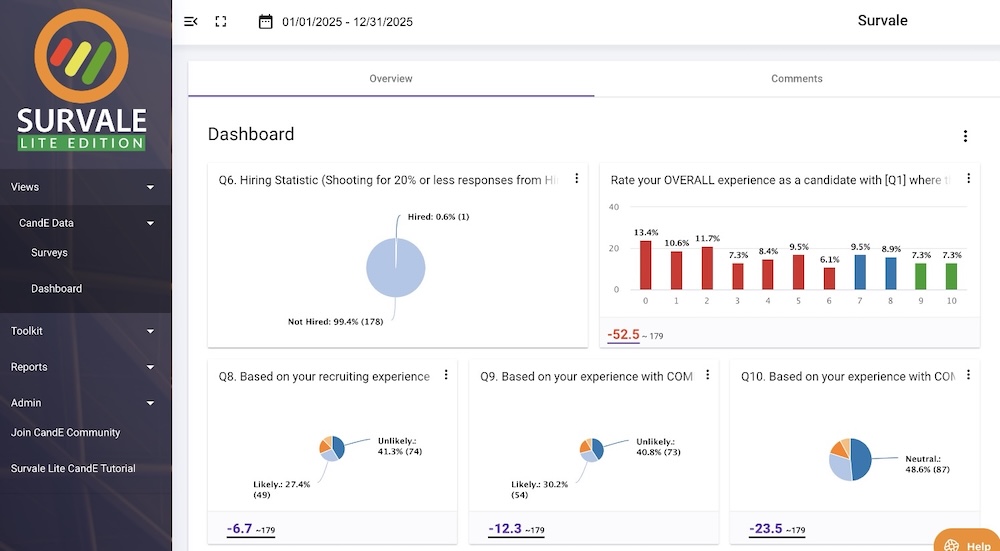
Back to survey fatigue – Question 6 in our CandE Benchmark survey asks the candidates what best describes the last step they completed in the recruiting process, which is required. Again, only the first 10 questions are required in our survey.
We had 55,000 candidate responses in North America in 2025.
- 46% said they completed a job application in Q6 — Of that group, nearly all completed through the application section and ratings
- 16% said they completed a screening and/or interview event in Q6 — Of that group, nearly all completed through the screening/interview section and ratings
- 14% said they had accepted an offer of employment in Q6 — Of that group, over 60% completed through the new hire section and ratings
Interestingly, this is where we have seen candidates drop off more because they have the most questions to answer, if they choose to answer them, which they’re more likely to do because they were hired.
Phew. I’m tired. Maybe this is where the fatigue sets in.
And although there are fluctuations in the completion of the non-required survey questions year after year, our data doesn’t show more candidates less likely to answer any of the questions.
Overall response rates have taken a slight hit in the past two years, but ours are still conservatively 5-10%+. We’d argue the painful candidate market (not necessarily what employers are doing or not doing experientially) and the fact that email deliverability has gotten more difficult have impacted response rates of late.
Whatever the response rates, more candidates answer our optional journey ratings because they know it’s third-party anonymous research where they can’t be identified, and they want their voice heard. If an employer is running their own continuous feedback, we do recommend that they suspend their campaigns for the duration of ours. Running duplicative candidate experience surveys isn’t a great experience.
There’s so much more we want to know each year about the candidate experience, and if we could ask them hundreds of questions, we would, and then we’d never get a survey answered.
And it’s great that more companies survey their candidates, whether it’s with 3-5 questions built into their ATS, or using another platform.
But if you want to compare your recruiting and hiring experiences against companies big and small across industries, leave the benchmarking to us. No need for survey fatigue.