
What Is Hiring Manager and Recruiter Alignment?
This alignment is one of the most consequential—and most overlooked—variables in talent acquisition operations.
The People Problem Nobody Talks About
Most TA leaders spend the majority of their optimization energy on systems: the ATS configuration, the sourcing channels, the job descriptions, the assessment tools. These seem visible, measurable, and relatively easy to adjust (but they’re not without the right tools—more on that here).
The harder problem is the one that sits between the technology: the coordination between recruiters and hiring managers. It is poorly understood, rarely measured, and almost impossible to improve without data.
Here is what we typically see happening with prospective clients. A requisition opens. The recruiter submits candidates. The hiring manager reviews slowly—or not at all. The recruiter escalates. The manager responds that the candidates aren’t strong enough. The recruiter disagrees or doesn’t understand the hiring manager’s needs. Meanwhile, the best candidate in the pipeline accepts another offer. Time-to-fill stretches. The role reopens.
Both parties believe they are right. Both are partially correct. And without a structured feedback mechanism, neither will ever know exactly where the process broke down or why.
This is not a personality problem. It is a structural one. And it has historically been nearly impossible to solve because the data needed to diagnose it simply wasn’t being collected.
Why Feedback Has Been So Hard to Collect and Act On
Traditional TA metrics are operational: time-to-fill, cost-per-hire, source of hire, offer acceptance rate. These are useful lagging indicators. They tell you that something went wrong. They cannot tell you why or where.
Annual engagement surveys and periodic process reviews capture some qualitative signal, but they arrive too late to be actionable and too infrequently to drive behavioral change. By the time a pattern is identified, dozens of hires have already been affected.
The gap between what TA leaders need to know and what they can actually measure has made people process optimization feel more like management consulting than operational management. It requires interviews, surveys you have to design and send manually, and analysis that most TA teams don’t have the bandwidth to conduct.
This is the core reason hiring manager and recruiter alignment has remained a soft, anecdotal problem for so long—not because it isn’t important, but because the tooling to address it systematically has not existed in most organizations.
Platforms purpose-built for talent acquisition feedback, like Survale, change this by automating feedback collection at the transaction level—triggering surveys automatically when key events occur in the ATS, so the data is continuous, timely, and tied to specific interactions rather than general impressions.
The Alignment Gap in Practice
The most common manifestation of poor hiring manager and recruiter alignment is what might be called the calibration gap: recruiters believe they are sending quality candidates; managers believe they are not. Neither can prove their position because there is no shared rubric and no mechanism for surfacing the disconnect.
A few patterns show up repeatedly:
The resume review delay. Candidates sit unreviewed for days or weeks while the manager’s calendar fills with other priorities. From the recruiter’s perspective, this is disrespect for the process. From the manager’s perspective, recruiting is not their main job. Both are right. Without data showing exactly how long reviews are taking—and whose reviews are slowest—there is no basis for a productive conversation.
The quality disagreement. When managers push back on candidate quality, the recruiter has no way to know whether the intake conversation was unclear, the job description is misleading, expectations have shifted, or the manager’s standards are simply unrealistic. Without structured feedback at the requisition level, this disagreement becomes personal rather than diagnostic.
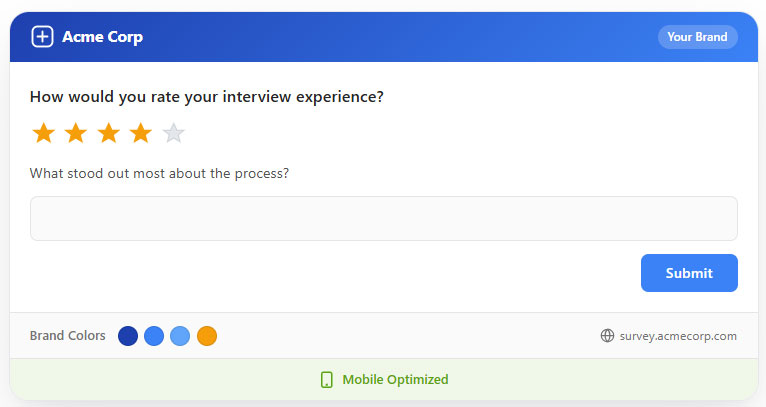
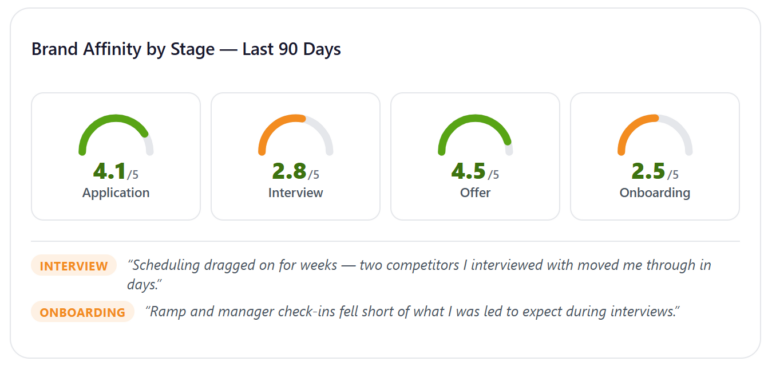
The interview experience gap. Candidates who leave an interview with a poor impression—feeling like the interviewer was unprepared, their time was disrespected, or just plain confused about the role—are significantly more likely to decline offers or ghost. Most hiring managers never receive feedback on how their interviews land. They have no idea that a behavioral pattern is costing the organization finalists.
Recruiter Effectiveness Beyond Fill Rate
Recruiters are typically measured on a narrow set of operational metrics: number of hires, time-to-fill, pipeline volume. These metrics reward speed and throughput. They say nothing about the quality of the candidate experience, the health of the talent pipeline, or whether the recruiter is building relationships that produce long-term value.
Candidate Net Promoter Score (cNPS) offers a more complete picture. When candidates are surveyed at each stage of the process, their responses create a recruiter-level performance signal that fill rate alone cannot provide. A recruiter who closes reqs quickly but leaves candidates feeling ignored will have low cNPS scores and a shrinking referral pipeline. A recruiter who takes slightly longer but runs a rigorous, communicative process will produce higher offer acceptance rates and more employer brand advocacy.
Recruiter effectiveness metrics worth tracking:
- Candidate NPS by recruiter, broken down by stage
- Communication quality ratings from candidate surveys
- Offer acceptance rate and NPS by recruiter
- Hiring manager satisfaction ratings by recruiter
- Stage-by-stage drop-off attributed to recruiter touchpoints
These metrics do not replace operational data. They contextualize it. A recruiter with a long time-to-fill and high cNPS is facing a process or manager problem. A recruiter with a fast time-to-fill and low cNPS is cutting corners that will show up in quality-of-hire data six months later.
Hiring Manager Accountability: Surfacing the Blockers TA Leaders Can’t See
Hiring manager accountability is the most politically sensitive lever in talent acquisition optimization—and the one with the highest upside.
Without feedback data, it is nearly impossible for a TA leader to walk into a conversation with a VP of Engineering and say: “Your team’s time-to-fill is 47 days longer than the company average, and here’s exactly why.” The data to support that conversation does not exist in most ATS platforms.
With structured feedback from both candidates and recruiters, the picture changes. When candidates consistently report that interviewers in a specific department seemed unprepared or unfamiliar with the role, that is a training signal. When recruiters consistently report that a specific manager takes more than five days to review submissions, that is an accountability signal. When offer decline rates for a particular team are above average and survey comments mention “the interview felt chaotic,” that is a root cause.
What good hiring manager accountability looks like in practice:
- Automated post-requisition surveys sent to hiring managers asking about candidate quality, recruiter communication, and process clarity
- Automated surveys sent to recruiters asking about manager responsiveness and intake quality
- Stage-level candidate feedback that ties specific delays to specific people or teams
- Aggregate dashboards that show manager-level patterns over time, not just individual incidents
The goal is not to punish managers. It is to give TA leaders the data they need to have productive, specific conversations—and to give managers visibility into how their behavior affects outcomes they care about, like headcount timelines and team performance.
A Practical Framework: What to Measure, When, and What to Do With It
Effective people process optimization in TA requires feedback at three levels:
1. The candidate level Survey candidates after application, after each interview stage, after offer, and after rejection. Look for patterns in communication quality, clarity of expectations, interviewer behavior, and overall experience. Segment by recruiter, department, and hiring manager.
2. The recruiter level Survey hiring managers after each requisition closes. Ask about candidate quality, process efficiency, and communication. Use the data to identify calibration gaps and coaching opportunities—not as a performance review, but as a diagnostic.
3. The hiring manager level Survey recruiters after each requisition closes. Ask about manager responsiveness, intake clarity, and decision-making speed. Aggregate this data by department to surface systemic patterns rather than individual outliers.
Feedback collected at this level is only useful if it triggers action. That means setting thresholds—a cNPS score below a certain level triggers a check-in; a review delay above a certain number of days triggers a flag to the TA leader; a pattern of low interviewer ratings triggers a training conversation.
The mechanics of this are straightforward when feedback is collected automatically and continuously. On the other hand, when feedback is based on manual surveys and periodic reviews, the lag makes it nearly impossible to act before damage is done.
Whether you’re a high volume hirer or an employer who lives and dies by the quality of the people you bring into the organization for key positions, the ability to optimize recruiter and hiring manager alignment is perhaps the single most important thing you can do to increase quality of hire.
FAQs
The most common cause is a lack of shared expectations at the requisition intake stage, combined with no ongoing feedback mechanism to surface when those expectations diverge. Without structured data, misalignments become visible only after they have already cost the organization candidates or extended time-to-fill.
The most effective approach combines recruiter-submitted feedback on manager responsiveness and intake quality with candidate feedback on interview experience, segmented by interviewer and department. This creates an objective, data-driven basis for accountability conversations rather than relying on anecdotal observation.
Candidate NPS (cNPS) measures whether candidates would recommend your hiring process to others, based on their experience at each stage. It provides a recruiter-level performance signal that fill rate alone cannot—revealing whether speed is coming at the cost of experience quality, offer acceptance, or employer brand reputation.
This article is part of Survale’s ongoing series on talent acquisition operations strategy. For a broader view of how feedback optimizes people, processes, and technology across the full recruiting stack, see the TA Operations Strategy Guide.