
“By the way, they’re human.”
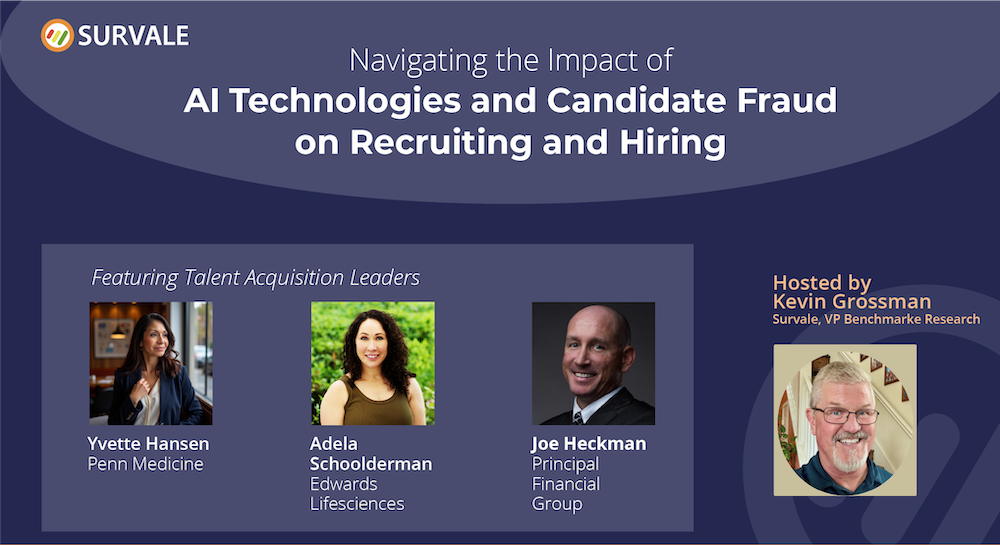
That was one of the quotes from our recent webinar titled “Navigating the Impact of AI Technologies and Candidate Fraud on Recruiting and Hiring”. It was from Adela Schoolderman, a TA leader from Edwards Lifesciences, and my co-author on the book Candidate Experience: How to Improve Talent Acquisition to Drive Business Performance. She was referring to real candidates.
Adela was part of the insightful panel discussion that I moderated, and also included TA leaders Yvette Hansen from Penn Medicine, and Joe Heckman from Principal Financial Group. A representation of healthcare, finance, and medical device manufacturing. They all shared how their organizations navigate AI implementation, manage the growing volume of fake applicants, manage the extreme application volumes of real candidates, and maintain the human element in hiring.
2026 CandE Benchmark Data
I opened the panel discussion by sharing some of our 2026 CandE Benchmark data. We’ll be writing the 2026 CandE research reports soon, so it was a good opportunity to share some of what the participating employers and their candidates are sharing this year.
Candidates who used generative AI to help with their resumes and cover letters:
- 11% – Hourly candidates
- 21% – Professional candidates
- 23% – Management candidates
For hourly, it’s nearly the same as last year, but it’s higher for professional and management candidates. I’d still argue this is underreported, even though our responses are anonymous.
Also noted on the candidate side:
- Less than 4% of all candidates said they used AI application platforms.
- Only 4% of all candidates said they had a phone screening call with an AI agent.
- 16% of all candidates said they had a one-way recorded video screening.
- One of the top 3 negative candidate sentiments is that they believe they’re being screened out by Artificial Intelligence after they apply.
For the employers, I shared that 2026 Implemented AI Technologies include:
- 45% – Basic Chatbot with some AI capabilities
- 36% – Screening, Matching, and / or Ranking Candidates
- 30% – Conversational AI Chatbot
- 30% – Sourcing Internal Candidate Databases
- 23% – Sentiment Analysis of Candidate / Employee Feedback
- 22% – Video Interviewing with Assessments
One of the webinar attendees thought that only 36% of employers using AI to screen was low, but based on the companies we work with, I believe it’s closer to the truth.
Also noted on the employer side:
- 71% of TA teams said they used generative AI to help with their job descriptions, candidate communications, etc.
- 51% of TA teams said they’re receiving applications from fake candidates.
- 39% of TA teams said they have processes and/or technologies in place to identify candidate fraud.
The Dual Reality of AI: Efficiencies vs. Fraud
Our CandE Benchmark data highlighted a shifting recruitment landscape. An AI escalation of sorts. However, this escalation has created a significant downside: candidate fraud.
Gartner projects that by 2028, 1 in 4 job applicants could be fake. These range from automated “application spam” via platforms like LazyApply.com to malicious identity fraud. Joe Heckman revealed that Principal Financial Group saw candidate pools for remote technical roles explode to 500–800 applicants within 24 hours, with estimations that 50% to 75% of those pools contained fraudulent or high-risk activity. He did clarify that it was an estimated percentage, but mercy me. He also noted instances where bad actors, including individuals with North Korean footprints, attempted to infiltrate corporate IT networks through fake applicant profiles, which I’ve heard from multiple other enterprises.
Implementing Guardrails and Layered Verification
To combat bad actors without sacrificing efficiency or compliance, our panelists emphasized that no single technology is a silver bullet. Instead, organizations must deploy a layered approach combining proactive tools and process discipline.
- Algorithmic Risk Scoring: Principal Financial Group partnered with verification platform Endorsed to process applicant data (addresses, phone numbers, LinkedIn profiles, and emails) and generate a high, medium, or low fraud risk score. (There are other similar platforms like Yardstik). Joe Heckman clarified that this score is never used to automatically reject applicants due to compliance regulations; rather, it allows recruiters to prioritize reviewing low-risk candidates first.
- Structured Interview Tactics: Simple human-driven processes remain highly effective. Recruiters at Principal Financial now conduct all initial screens on camera via Microsoft Teams and routinely ask candidates to verbally confirm basic application details.
- On-Site Vetting: In healthcare, where credentialing directly impacts patient safety, Yvette Hansen explained that Penn Medicine combines strict downstream background checks with upstream controls. To counteract highly polished or AI-fabricated resumes, Penn Medicine has shifted away from purely virtual interviews back toward on-site visits, work shadowing, and face-to-face evaluations.
Balancing AI Efficiency with the Human Touch
While managing risk is critical, TA leaders are also leveraging AI to give time back to their recruitment teams.
At Penn Medicine, an automated screening agent was introduced for high-volume roles to respond to candidates faster and provide consistent touchpoints. Yvette said that the goal wasn’t for AI to make a hiring decision, it was to make sure they could respond to candidates quickly and give every applicant an opportunity to be heard (love that). This frees up their recruiters to focus on consultative hiring manager meetings and relationship-building.
Similarly, Principal Financial uses Microsoft Copilot to transcribe and summarize interviews. Removing the burden of manual note-taking allows recruiters to hold more engaging, human conversations while generating consistent, unbiased interview summaries. They also utilize AI-driven role-playing platforms through LinkedIn Learning, allowing internal employees to practice and improve their interview skills in a simulated environment.
Back to Basics: Core Recruitment Discipline
Despite the rise of sophisticated software, the panel agreed that technology cannot replace core recruitment fundamentals and the human touch.
Adela Schoolderman cautioned against viewing every AI-using candidate as fraudulent, urging TA leaders to distinguish between candidates using modern tools to write resumes and malicious entities intending to mislead. She warned that putting up excessive technical barriers risks cutting off access to genuine, diverse talent.
Adela noted that Edwards Lifesciences intentionally maintained a “wait and see” approach to AI candidate screening, doubling down on traditional sourcing methods, building strong regional employer brands, and serving as strategic talent advisors to business leaders. She said they are trying to hire humans; they are not hiring AI operators.
The panel agreed that combatting candidate fraud and handling high application volumes ultimately comes down to holding hiring managers accountable to structured interview frameworks, asking detailed follow-up questions, and maintaining rigorous evaluation standards.
Key Recommendations for TA Leaders
The following are key recommendations the panel left the attendees with:
- Adopt a Layered Approach: Combine basic human verification checks (e.g., identity confirmation, structured camera interviews) with downstream background checks and optional fraud-scoring technology.
- Prioritize Human Decision-Making: Keep recruiters and hiring managers at the center of final hiring decisions to maintain compliance and preserve candidate trust.
- Involve Compliance Early: Engage legal, privacy, and IT security teams early when vetting AI vendor technologies to streamline adoption.
- Upskill Hiring Managers: Offer regular structured interview training so hiring teams know how to probe beyond surface-level responses.
- Listen to Candidates and Recruiters: Continuously gather feedback to identify friction points in the hiring process and remove unnecessary barriers for genuine applicants.
There were many super takeaways from this panel discussion. And when Adela Schoolderman reminded us all that candidates, by the way, are human, we all concurred.
She was talking about real candidates in recruiting and hiring. Those who are attempting to navigate economic uncertainty and a tough job market. But she might as well have been talking about all of us: candidates, recruiters, hiring managers, and everyone else in business today grappling with an overwhelming AI world.
By the way, we’re all human.