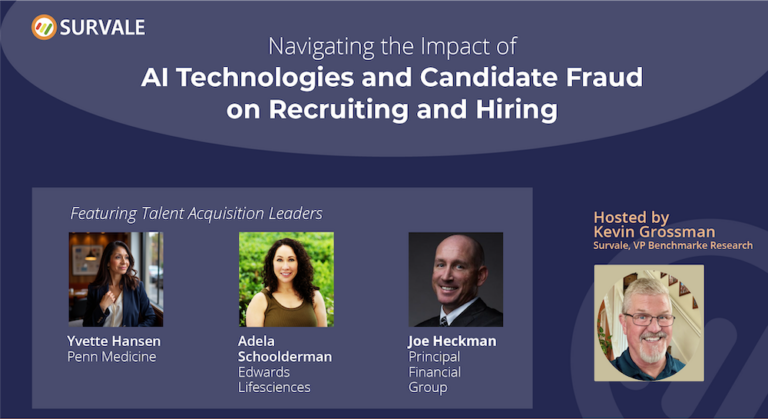

While prepping for a panel discussion about candidate and hiring manager experience, one of the TA leader panelists said – “I don’t need to survey my candidates; I know exactly what needs attention.”
What’s true about this is that most TA teams should know what needs attention and what’s working in their recruiting and hiring from pre-application to onboarding. I’d argue they should still survey their candidates (including employees – internal candidates) and benchmark their candidate experience against other employers, but you already knew that.
Whether you know much about our CandE Benchmark Research program or not, we’ve again completed another benchmark year and the 2026 CandE Winners have been announced, the participating employers that have near-to-above average ratings in our research.
We did have fewer employers participate this year compared to last, but it continues to be a bizarre global business environment all around. Hiring’s flattish. Workers are staying put (for now). The job market continues to be painful for salaried professionals and management candidates. TA teams getting leaner and “retooling”. Reevaluating tech stacks. For some, the unsaid thing is not wanting to survey their candidates in this market. Again, you know where I stand on that one.
Whatever the case, the lead always seems to be negative, when in fact, there are both positive and negative impacts (which can also depend on your vantage point). Here are some of the business impacts we’ve seen in the past year:
Global and US Economies
- Positive Impact: Stabilizing inflation and interest rate cuts by major central banks have lowered borrowing costs, helping boost business sentiment and capital investment. AI integration across key industries has also begun yielding tangible, productivity-driven economic expansion. Everchanging, of course.
- Negative Impact: Persistent global trade tensions, tariffs, and regulatory shifts continue to fragment supply chains and restrain international trade volume. In the US, economic momentum remains constrained by a “sluggish expansion” environment characterized by modest overall GDP growth.
Job Growth
- Positive Impact: Healthcare, construction, and green energy sectors have consistently added jobs, stabilizing national unemployment rates at historically manageable levels. In addition, private-sector hiring has shown steady localized gains across specific service industries.
- Negative Impact: White-collar sectors, tech, and federal government roles have experienced ongoing headcount contractions and hiring. It’s been an especially difficult job market for salaried professionals, management, and senior leadership candidates.
Recruiting and Hiring
- Positive Impact: Many organizations have adopted skills-based hiring over strict degree requirements, significantly broadening talent pools and reducing bias. Simultaneously, agentic AI tools have streamlined routine administrative scheduling and candidate sourcing for some talent teams.
- Negative Impact: Widespread candidate use of generative AI has flooded job boards with hyper-tailored application spam, creating severe screening bottlenecks for recruiters. Talent acquisition teams have also faced burnout and reduced headcounts while managing record-high applicant volumes per open role.
Candidate Experience
- Positive Impact: Salary transparency mandates in job postings have provided applicants with much-needed upfront clarity regarding total compensation. Automated screening processes have also shortened the initial time candidates wait to hear if they qualify for an interview.
- Negative Impact: High application volumes have led to an increase in candidate “ghosting” after multiple round interviews and automated rejections. Additionally, candidates’ perception that most employers are using AI assessments during hiring has left candidates feeling alienated by a lack of human connection.
That last negative impact is a doozy. It continues to be part of the greater negative sentiment themes we’ve seen in our benchmark research for many years, but especially now because of AI and the perception (and misperception) of AI.
And the AI regulations are sparse, but they’re here, with more sure to come like these:
Under the EU AI Act, AI systems used in recruitment, candidate ranking, and employee evaluations are classified as “high-risk” tools subject to strict regulatory oversight. The law mandates explicit transparency notices for job applicants, continuous bias monitoring, technical logging, and human oversight, while outright prohibiting AI emotion recognition in the workplace.
NYC Automated Employment Decision Tools (AEDT) Law (Local Law 144)
Enforced in New York City, this pioneering law targets automated systems that screen, rank, or filter candidates without primary human involvement. Employers must publish an independent, annual bias audit measuring disparate impact on protected groups and provide candidates with advance notice and an opportunity to request accommodations before being evaluated by AI.
State-Level Anti-Bias and ADMT Laws
U.S. states like California, Colorado, Connecticut, and Illinois have implemented state-level regulations prohibiting employment discrimination caused by Automated Decision-Making Technology (ADMT). These laws mandate advance notice to applicants when AI screening software is being used, require mechanisms for human review in adverse hiring decisions, and hold employers liable if an algorithm creates an unlawful disparate impact.
US Facial Recognition and Asynchronous Interview Laws
State statutes in locations like Maryland and Illinois directly govern the use of AI tools in video interviews and biometric analysis. Employers are legally required to obtain written consent from applicants before utilizing facial recognition or AI-driven voice analysis during video submissions and must adhere to strict data deletion schedules.
Interestingly, this year’s CandE Award Winners skewed even more positively in their ratings than in previous years, which we’ll unpack further in our research reports to come out by the end of the year.
On the other hand, candidate resentment – those candidates who will not engage a business or brand again after a poor candidate experience – is the highest it’s been in North America in the 15 years we’ve been measuring it: 16%. Candidates today too often feel alienated by quick application rejections, sparse communications, and post-interview ghosting. And we have 77,000 candidate responses that tell all.
However, it’s down in our EMEA, APAC, and Latin America data, due the same positive skew of CandE Winners globally this year. Improving the candidate experience isn’t just the right thing to do — it’s a vital long-term investment in relationships, human connection, and sustainable business outcomes in any market.
Congratulations to the 2026 CandE Winners for prioritizing empathy, transparency, and genuine human connection amidst modern recruiting challenges.