
The first time I saw someone post their high candidate experience rating with the caption that read “Rated by Real Candidates”, I didn’t quite understand what that meant.
If you’re surveying your own candidates across candidate journey stages, no matter how you’re doing it, and no matter how they respond (positively or negatively – warts and all), wouldn’t they all be “real candidates”? Otherwise, are we talking about outright fabricated candidates? Or, bad actors from other countries pretending to be candidates? Or, AI bots pretending to be candidates?
Wait, can AI answer surveys like humans?
Yes, they can. But, when you’re surveying for your own candidate experience, like with Survale and the CandEs, you’re not sending your candidate surveys to bots; you’re sending them directly to your human candidates via email and/or text. And even if an AI bot received one, it will struggle to mimic natural human behavior and identity markers. You can catch AI bots using different modes of detection. For example, rapid responses at unnatural fixed intervals (i.e., exactly 2.5 seconds per page) and autofilling input in every field of every question on every page (which humans don’t do).
If we’re talking about human candidates who augment their applications using career coaches, resume writers, and now generative AI to stand out, they’re still human and technically real candidates. Plus, all of the former has been going on way before mainstream AI was here.
TA teams today understand that fake candidates are on the rise as well as fraud. TA leaders and recruiters are having their identities stolen to bilk unsuspecting candidates of their money. For fraud, I recommend that TA teams check out Fraud Squad led by longtime talent acquisition pro Stacy Zapar of Tenfold. Fraud Squad is a free community of verified talent acquisition practitioners working together to fight candidate fraud.
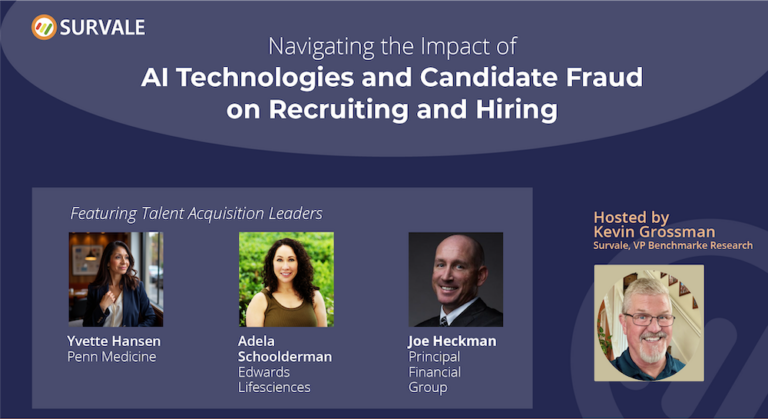
Also, make sure you check out our upcoming webinar on August 26: Navigating the Impact of AI Technologies and Candidate Fraud on Recruiting and Hiring featuring talent acquisition leaders from Penn Medicine, Principal Financial Group, Edwards Lifesciences, and Lyric.
In regards to fake candidates, 51% of participating employers in this year’s CandE Benchmark Research Program said they’ve received applications from fake candidates, but only 53% of those have processes and/or technologies in place to mitigate them.
Fake candidate experience feedback has never been an issue for us, though. In the 15 years we’ve been benchmarking candidate experience, only one employer vehemently doubted the veracity of their candidate feedback. So much so that after they told me they didn’t believe they were their candidates, they terminated the call and never responded again. Unless they sent their survey links to another group of candidates outside their organization, which was highly unlikely, it was their job candidates.
Because when organizations are surveying their candidates about their experiences, the surveys are usually triggered by their ATS status changes (Survale Enterprise integrates directly with your ATS to do this). Surveying after dispositioned post-application, after screening, after interviewing, after offer acceptance, etc. This is predicated by the fact that the candidates were screened and vetted to be authentically human post-application.
Fake and fraudulent candidates are here to stay, but your “real” candidate experience is your candidate experience. Positive and/or negative – warts and all.