
A journalist asked me recently what employers owe job candidates. I responded that employers don’t owe them anything, because “owe” is the wrong word.
Instead, employers “can” and “should” be timely and consistent with their communication and feedback loops to all candidates – external or internal. At any and all stages. Especially when candidates are dispositioned, declined, regretted, rejected – however your HR and talent acquisition teams define telling a candidate “no thank you”.
This is important in any market around the world, and right now the candidate market ahead in 2026 is going to be rough. Just as rough if not more so than in 2025. The roughest of the market will continue to be for salaried professionals, management, and senior leadership. Layoffs continue and economic uncertainty abounds (Amazon just laid off 16,000 and some of those individuals received an email a day earlier sent in an apparent error acknowledging “organizational changes” at the company). Wow. And if new college grads thought the 2025 job market was rough for them, look out, kids, ‘cause another storm is brewing.
It’s true that anything can happen and economic shifts (and shafts) can morph and change, impacting business forecasting, and ultimately, recruiting and hiring. But for now, frenetic uncertainty is here to stay.
Back to employers and their job candidates. Application volumes have skyrocketed for many midsized to global enterprises.
Our 2023 CandE Benchmark Research revealed that:
- 49% of employers with 10,000+ employees globally told us they had 51+ applications per job posting.
- 13% told us they had 200+ applications per job posting.
But our 2025 CandE Benchmark Research showed that:
- 64% of employers with 10,000+ employees globally told us they had 51+ applications per job posting.
- 21% told us they had 200+ applications per job posting.
That equates to a 31% increase since 2023 when there were 51+ applications per job posting and a 62% increase when there were 200+ applications per job posting. With more candidates using AI platforms and tools to apply and be seen, and more employers using AI platforms and tools to screen out, the AI recruiting-and-hiring escalation between candidates and employers is here to stay.
And that’s going to lead to more candidate resentment. Candidate resentment as we measure it – the percentage of candidates who said they had a poor candidate experience and won’t apply again, refer others, be brand advocates, or be customers – is the highest it’s ever been in the 14 years we’ve been doing CandE Benchmark Research. Unfortunately, I predict it will continue to increase in 2026.
We’ve also worked with over 2,000 companies since the beginning of the CandEs as we’re known, 75% being midsized to global enterprise. Each year very large companies (over 10,000 employees) complain that it’s difficult to maintain a quality candidate experience and respond effectively to each and every job candidate, especially if they’ve seen volume increases like the past few years. They feel that smaller companies have the time, staff, and resources to better respond to lower applicant volumes, and hence, have a better quality candidate experience.
Well, we’ve had many Fortune 100 companies participate in our research and those that have won CandE Awards – those companies with near-to-above candidate experience ratings. Some have won multiple CandE Awards.
Past Fortune 100 CandE Winners
| Amazon | Fannie Mae | MetLife |
| American Airlines | Ford Motor Company | PepsiCo |
| AT&T | General Dynamics | Progressive Insurance |
| BMS (Bristol-Myers Squibb) | General Motors | Procter & Gamble |
| Capital One | Humana | Prudential Financial |
| Cigna | Intel | Verizon |
| Comcast Corporation | Johnson & Johnson | Walgreens |
| CVS Health | Lily | Wells Fargo |
| Dell | Lockheed Martin Corporation | |
| Delta Air Lines | McKesson Corporation |
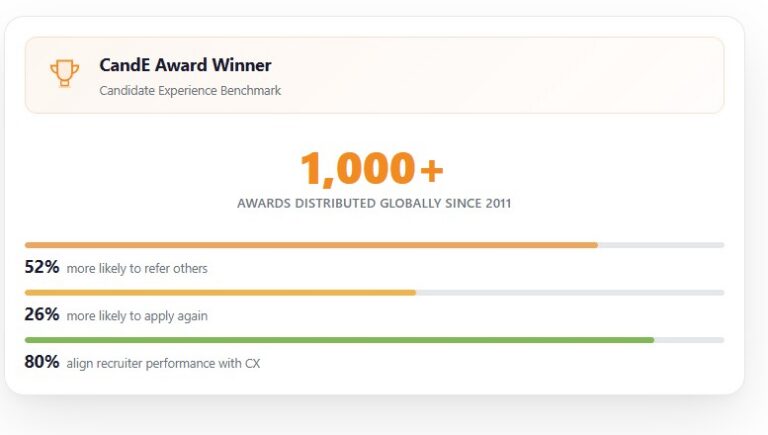
Sustaining a quality candidate experience over time is the hard part, but when you read our latest What Sets CandE Award Winners Apart research brief, it’s clear that timely and consistent communication and feedback investments pay off.
Since our 2025 Global CandE Benchmark Research Report is now available, here are 3 of the 10 overall key takeaways that can make all the difference with your candidates you don’t hire and their willingness to engage your business and the brand again.
TIMELY DISPOSITIONS ALWAYS A DIFFERENTIATOR
69% participating employers in our research were focused on timely dispositions within 1-2 weeks, but CandE Winners still dispositioned candidates more often within 3-5 days – about 4% more often in 2025 compared to all participating employers. And 60% of the top 10 North America CandE Winners said they disposition within 3-5 days in 2025, 16% more often than all employers.
CANDIDATES WAITING TO HEAR BACK
More CandE Winners were also keeping fewer candidates waiting to hear back after they applied, another key differentiator of a positive candidate experience. The longer candidates have to wait, the more negative their experience becomes. Keeping candidates in the loop helps them see where they stand and demonstrates respect for their time and efforts. In 2025 all CandE Winners in North America kept 61% fewer candidates waiting on next steps 2+ months after applying, a significant difference.
FINALIST FEEDBACK INCREASES WILLINGNESS TO REFER AND ENGAGE
Most of the highest-rated companies in our 2025 research provided some level of feedback to finalists, and CandE Winners overall gave 20% more feedback to finalists than all other companies combined in 2025. And here’s why giving feedback can pay off: When specific feedback was given to candidates, their willingness to refer others NPS rating increased 69% in 2025. Their willingness to increase their relationship with the employer NPS rating increased by 64%.
Most job candidates aren’t getting the job, whether it’s a booming market for them or the frozen tundra market of today. Candidates want feedback, but most won’t get it, not even finalists. Candidates want timely responses and closure, but being ghosted was one of the top negative sentiments from candidates in 2025.
Employers big and small across industries don’t “owe” candidates anything, but again, they can and should communicate consistently across the candidate journey. That will lead to more candidates having increased positive sentiment and perception of fairness, ultimately leading to lower candidate resentment and potential positive business impact.